
10 Common Mistakes Students Make During Campus Placements
The placement mistakes that quietly cost offers - and a practical way to correct each one before interview season.
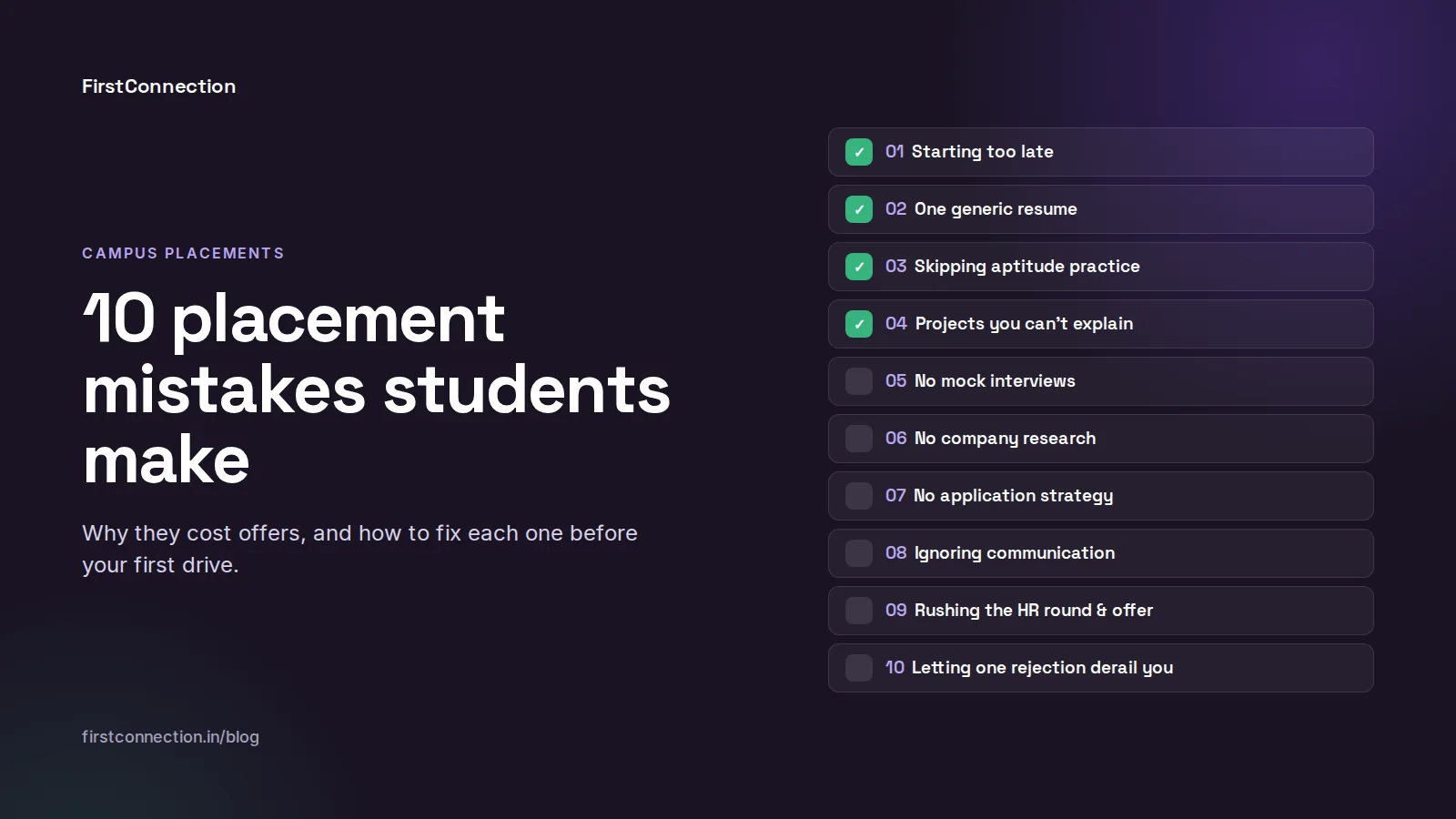
Short answer: The most common campus placement mistakes are starting preparation too late, using a generic resume, ignoring aptitude and online-assessment practice, listing projects or skills you can't explain, skipping mock interviews, not researching companies, having no application strategy, neglecting communication, mishandling the HR round and offer details, and letting one rejection derail you. Almost all of them come down to preparing late or preparing blind, and almost all are fixable in a few focused weeks.
Key takeaways
- The online assessment eliminates the most candidates in many drives, so practise it as seriously as interviews.
- Your resume is a list of things you'll be asked about. Only include what you can defend.
- Mock interviews are the highest-return preparation. Most students skip them.
- Know your placement policy (dream and non-dream categories, one-offer rules) before you apply.
- Rejections are data. Track them, find the pattern and fix it.
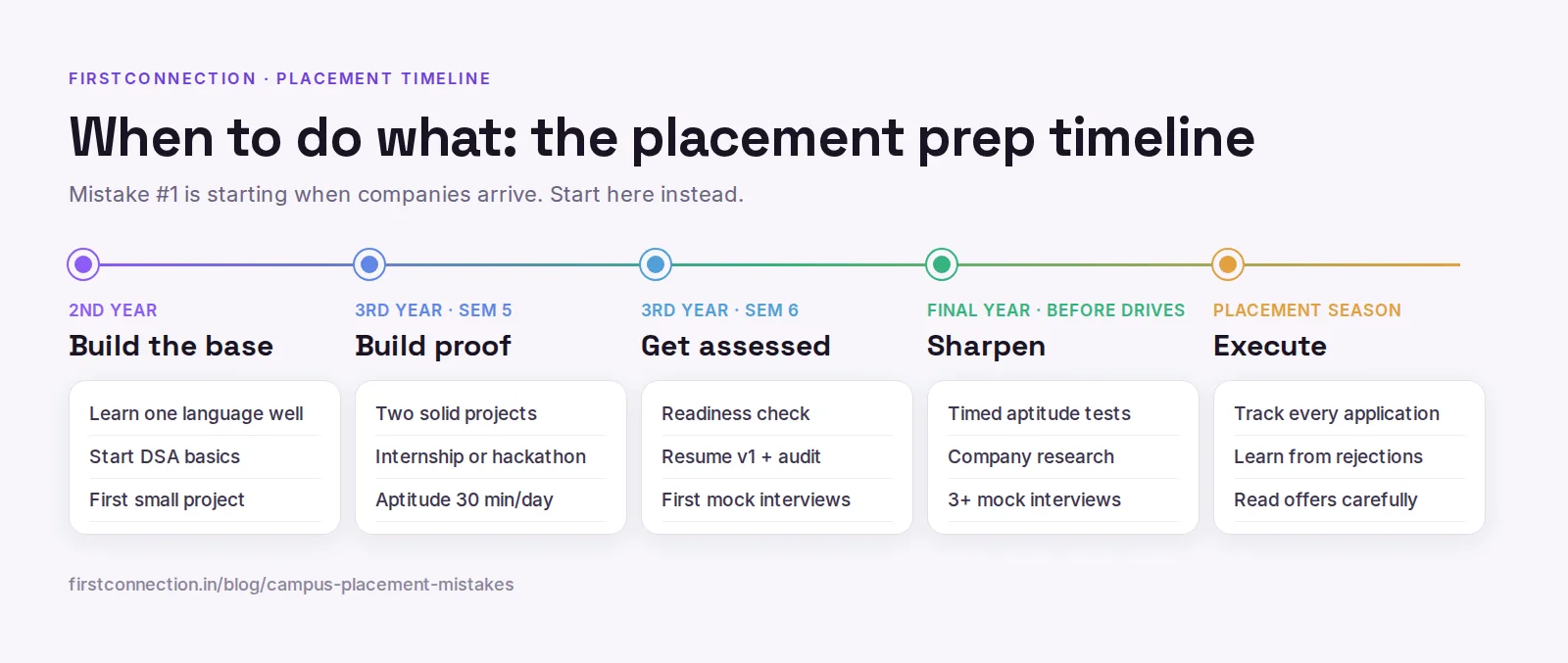
1. Starting preparation only when companies arrive
The mistake: Waiting for the first company notification in final year to begin aptitude practice, coding and resume work.
Why it costs you: Placement season moves fast. Tests, interviews and results can happen within days, and there is no time to build skills from zero while also attending drives.
The fix: Start in your third year. Spend 30–45 minutes a day on aptitude and coding, build two meaningful projects, and update your resume each semester. If you're already in final year, start with a readiness check so you work on your real gaps first.
2. Using one generic resume for every company
The mistake: A two-page resume with an objective statement, a long list of skills and no links or measurable outcomes, sent unchanged to every company.
Why it costs you: Recruiters and applicant-tracking systems scan for role-relevant skills and proof. A generic resume looks like no particular fit.
The fix:
- Keep it to one page.
- Put projects and internships above hobbies and school marks.
- Add proof: GitHub links, live demos, certificates, measurable results ("reduced page load time from 4s to 1.5s").
- Adjust the skills and project order for each role type (service, product, analytics).
- Check for typos twice. It's the easiest way to be rejected.
3. Ignoring aptitude and online-assessment practice
The mistake: Focusing only on interviews and assuming the aptitude test will be easy.
Why it costs you: In many campus drives, the online assessment filters out the largest number of candidates before any interview happens. Strong coders get eliminated because of time pressure in quantitative aptitude or logical reasoning.
The fix: Take at least two timed full-length practice tests a week in the month before placements. Track accuracy and time per section, not just total score. Revise formulas for percentages, ratios, time and work, and probability. Practise easy-to-medium coding problems under a timer.
4. Listing skills and projects you can't explain
The mistake: Adding every technology you've touched, or a project copied from a tutorial or a teammate, to make the resume look stronger.
Why it costs you: Interviewers almost always pick something from your resume and go deep. One project you can't explain undermines your credibility for the rest of the interview.
The fix: For each project, prepare answers to: What problem does it solve? Why this tech stack? What was the hardest bug? What exactly did you build? What would you improve? If you can't answer these, strengthen the project or remove it. Read our technical interview preparation guide for freshers for a full project-prep framework.
5. Skipping mock interviews
The mistake: Preparing alone, silently, from notes and videos, and treating the real interview as the first time you answer questions out loud.
Why it costs you: Knowing an answer and explaining it clearly under pressure are different skills. Many students who "knew everything" freeze or ramble in the actual room.
The fix: Take at least three timed mock interviews before placement season, covering technical and HR. Record yourself or use an AI mock-interview tool so you can see filler words, long pauses and unclear explanations. Then repeat the mock after fixing them.
6. Not researching the company and the role
The mistake: Walking into an interview without knowing what the company does, who its customers are, or what the role involves.
Why it costs you: "Why do you want to join us?" and "What do you know about our company?" are among the most common HR questions. A vague answer signals that you're applying everywhere without interest.
The fix: Spend 30 minutes per company: read their website and recent news, read the job description line by line, and ask seniors about last year's process. Write three specific reasons you want to join. Our list of the top 25 HR interview questions for freshers includes sample answers for these.
7. Having no application strategy
The mistake: Either applying to every company without a plan, or holding out only for one dream company, without understanding the placement policy.
Why it costs you: Many colleges use rules such as one-offer-per-student or dream and non-dream categories. Students sometimes accept an early offer they don't want and get locked out of better ones, or skip safer options and finish the season unplaced.
The fix: Read your placement policy carefully. Make a simple tracker with each company's role, package, eligibility, dates and your status. Plan a mix of ambitious, realistic and safer applications, and only apply to roles you would genuinely accept.
8. Neglecting communication and group discussions
The mistake: Assuming technical skill alone is enough and ignoring spoken English, group discussions and presentation.
Why it costs you: Communication is assessed in every round: GDs, technical explanations and HR. A strong candidate who can't explain their reasoning is often rated below an average candidate who can.
The fix: Speak every day. Explain a concept to a friend, record a two-minute answer to a common question, or join a club where you have to present. In GDs, make two or three strong, structured points, build on others' ideas and avoid interrupting. Clarity matters more than vocabulary.
9. Mishandling the HR round and the offer details
The mistake: Treating HR as a formality, hiding backlogs or gaps, and accepting offers without reading them.
Why it costs you: HR can reject candidates over dishonesty or a poor fit, and an offer you don't understand can surprise you later with a service bond, a relocation condition or a CTC that is mostly variable.
The fix: Be honest about backlogs, gaps and other offers. Before you accept, check the CTC breakup (fixed vs variable, in-hand estimate), bond or service-agreement terms, joining date, location and training period conditions. Ask your placement cell or HR to clarify anything unclear. It's a normal, professional question.
10. Letting one rejection derail the season
The mistake: Losing confidence after one or two rejections, stopping preparation or applying without changing anything.
Why it costs you: Placement season is a series of attempts. Students who keep the same approach after a rejection usually repeat the same result.
The fix: After each rejection, write down the round you were rejected in and the likely reason. After three entries, look for the pattern. Is it the aptitude round, projects, communication or the HR round? Fix that specific gap. And remember that campus is not the only route. Off-campus applications, referrals and direct recruiter connections are often how freshers land their first role.
A quick placement-readiness checklist
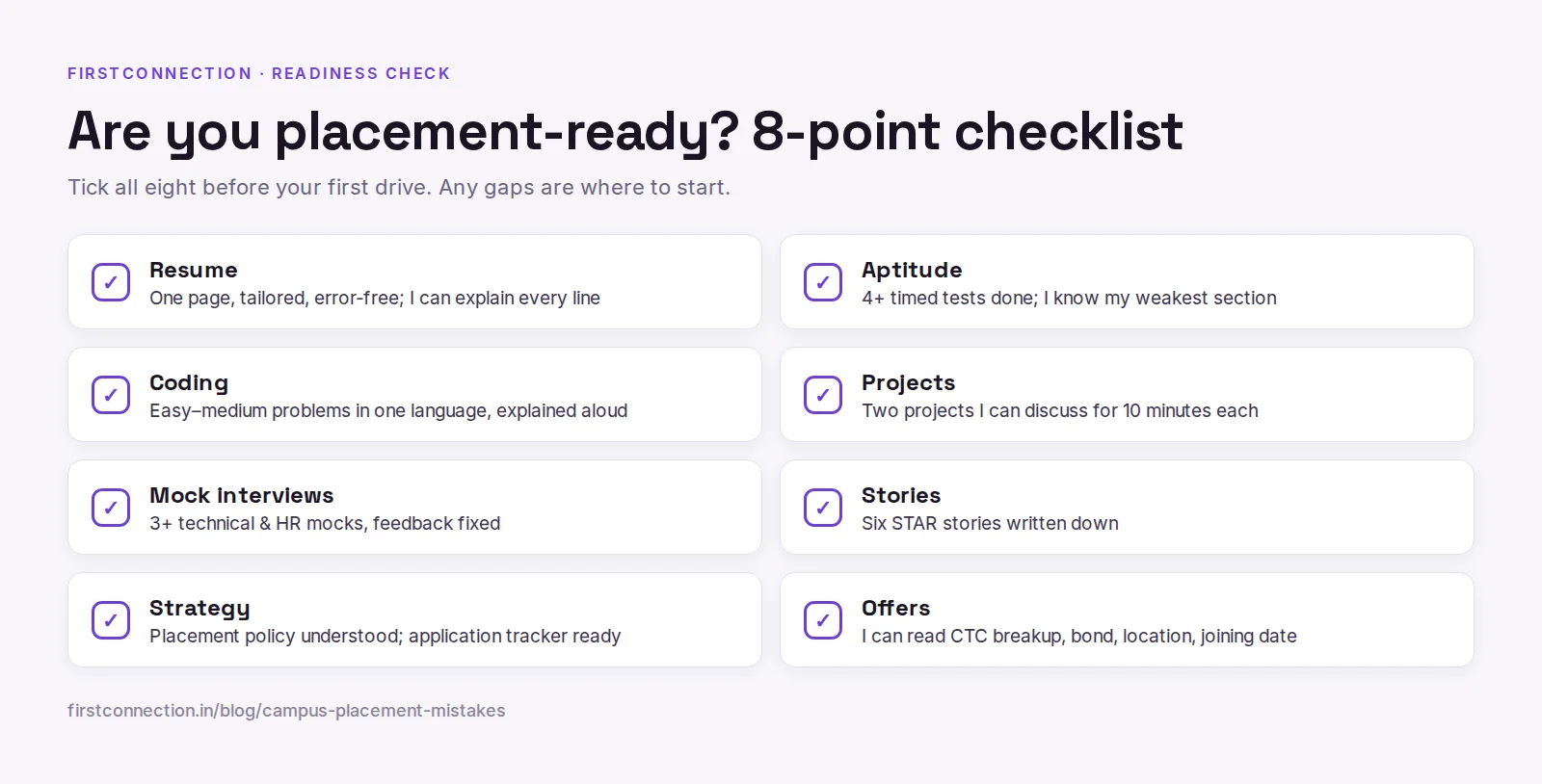
Before your first drive, you should be able to tick all of these:
- My resume is one page, tailored and error-free, and I can explain every line of it.
- I've taken at least four timed aptitude tests and know my weakest section.
- I can solve easy-to-medium coding problems in one language while explaining my approach.
- I have two projects I can discuss in depth for ten minutes each.
- I've done at least three mock interviews (technical and HR) and fixed the feedback.
- I've written down six STAR stories for behavioural questions.
- I understand my college's placement policy and have a tracker for applications.
- I know how to read an offer letter: CTC breakup, bond, location and joining date.
How FirstConnection helps you avoid these mistakes
- Know where you stand with Bharat Audit: a 75-minute, four-module placement readiness assessment that shows your gaps before placement season starts, so you fix mistakes 1, 3 and 4 early.
- Get a free resume audit on the FirstConnection candidates page to fix mistake 2.
- Practise in Interview Arena: role-wise AI mock interviews with a detailed Credo Report, for mistakes 5 and 8.
- Go beyond campus with DTR Connect, where you can speak to recruiters directly on WhatsApp. It's useful for mistakes 6 and 10.
Check your placement readiness with Bharat Audit →