
How to Prepare for a Technical Interview as a Fresher
What interviewers actually test, what to revise in four weeks, and how to think out loud when you get stuck.
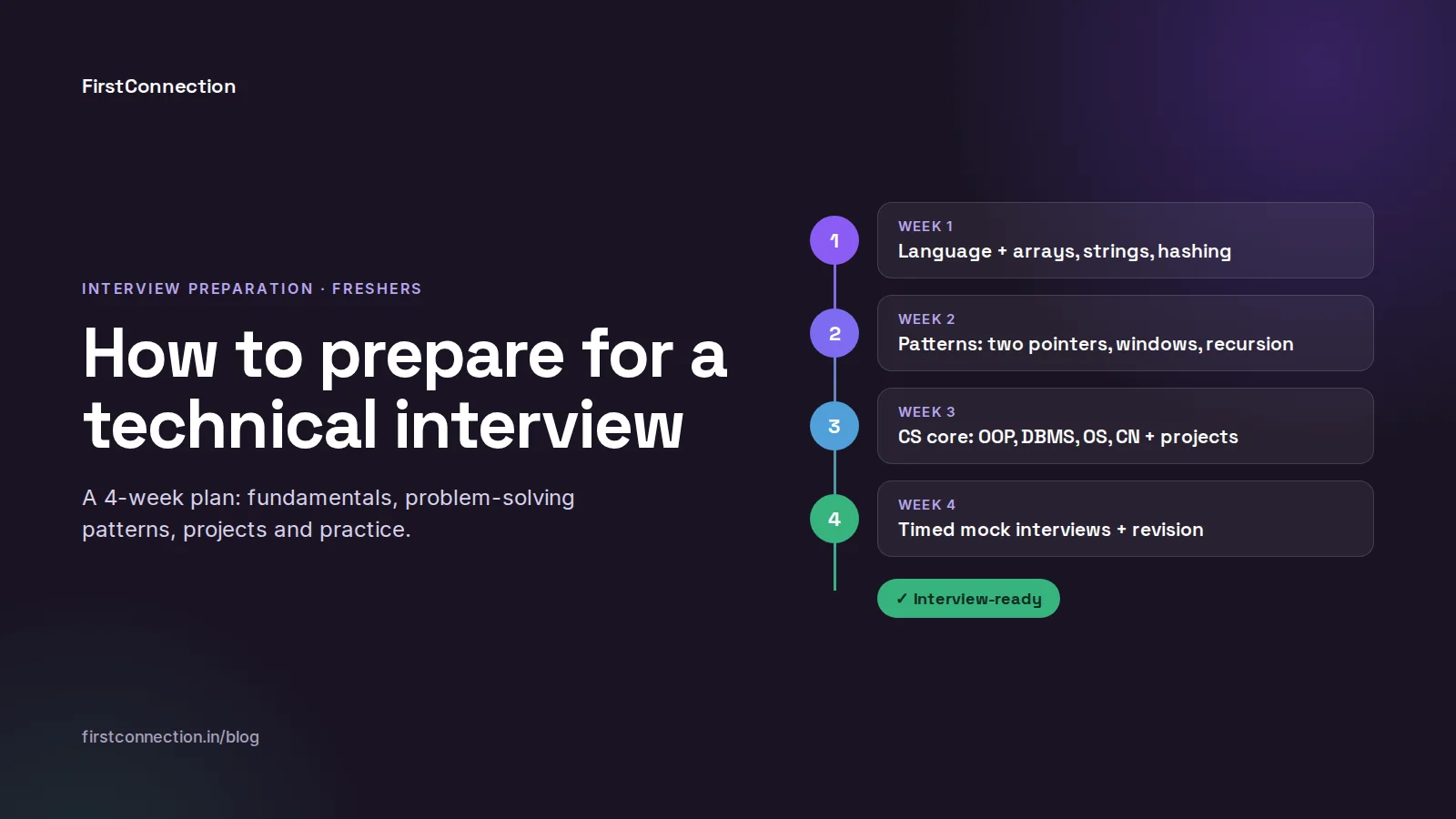
Short answer: To prepare for a technical interview as a fresher, choose one programming language and master it, practise the core data-structure patterns until you can solve problems out loud, revise four core subjects (OOP, DBMS, Operating Systems and Computer Networks), prepare every project on your resume like a viva, and take at least three timed mock interviews before the real one. With 2–3 focused hours a day, four weeks is enough for most campus roles.
Key takeaways
- Technical interviews for freshers test fundamentals and reasoning, not genius. Interviewers want to see how you think.
- One language, deeply beats three languages superficially.
- Learn patterns, not individual questions. Around 120–150 well-understood problems cover most campus interviews.
- Your projects are the easiest marks you can win or lose. Prepare five questions for each.
- Practise out loud. Solving silently in your room and explaining live to an interviewer are two different skills.
What does a technical interview for freshers actually test?
Most freshers assume the technical round is a test of how many questions they have memorised. It isn't. An interviewer hiring a fresher is trying to answer five questions about you:
- Are your fundamentals solid? Can you write correct code, and do you understand OOP, databases and how a computer works?
- Can you solve a problem you haven't seen before? They watch your approach more than your final answer.
- Can you explain your thinking? In a real team you will explain decisions every day.
- Did you actually build what's on your resume? Projects are checked hard because they are easy to copy.
- Can you learn? When you get stuck, do you freeze, or do you reason your way forward?
Here is how a typical campus hiring process is structured, and what each stage checks:
Not every company follows all four stages. Service companies often combine technical and HR rounds, and startups may add a take-home assignment. The point is that each stage is predictable, so you can prepare for each one.
Step 1: Understand the role and the company before you revise anything
Start with the job description. A "Software Engineer" role at a product company, a "Systems Engineer" role at a large IT services firm and a "Full-Stack Developer" role at a startup are three different interviews.
- IT services companies usually focus on programming basics, simple coding problems, OOP, DBMS/SQL and your projects.
- Product companies push harder on data structures, algorithms and problem solving, often with two or more coding rounds.
- Startups often care most about what you have built. Expect questions on your stack, your GitHub and sometimes a short practical task.
Ask your placement cell or seniors what last year's process looked like for the same company. It's the cheapest, most accurate preparation material you will find.
Step 2: Pick one programming language and go deep
Interviewers don't care whether you use Java, C++ or Python. They care whether you can use it fluently. Pick the language you are most comfortable with and make sure you can:
- Write loops, functions and recursion without looking anything up.
- Use the standard collections confidently: arrays/lists, hash maps, sets, stacks, queues and sorting.
- Explain the time complexity of common operations (for example, why a hash-map lookup is O(1) on average).
- Handle strings and input/output cleanly, because many fresher problems are string problems.
- Answer language-specific basics: memory management, `==` vs `.equals()` in Java, pointers vs references in C++, mutable vs immutable types in Python.
Step 3: Learn DSA by patterns, not by question count
You don't need 500 problems. You need to recognise roughly a dozen patterns and apply them calmly. Prioritise in this order:
- Arrays and strings: traversal, prefix sums, in-place operations.
- Hashing: frequency counts, duplicates, two-sum style lookups.
- Two pointers and sliding window: pairs, sub-arrays, substrings.
- Sorting and binary search: including "search on the answer" problems.
- Recursion and backtracking: subsets, permutations, simple combinations.
- Linked lists: reversal, cycle detection, merging.
- Stacks and queues: balanced brackets, next greater element.
- Trees: traversals, height, level-order, binary search trees.
- Basic dynamic programming (mainly for product companies): Fibonacci-style problems, knapsack basics, longest common subsequence.
For every problem you solve, write one line in a notebook: the pattern, the trick and the complexity. Before the interview, revise the notebook, not the problems.
Step 4: Revise the four core CS subjects
Fresher interviews return to the same fundamentals again and again. You don't need textbook depth. You need clear, example-backed answers.
Object-Oriented Programming Know the four pillars (encapsulation, abstraction, inheritance and polymorphism), each explained with a real example from your own code. Be ready for: method overloading vs overriding, abstract class vs interface, and composition vs inheritance.
DBMS and SQL Know normalisation (1NF to 3NF), primary vs foreign keys, joins, indexes, transactions and ACID properties. Write SQL by hand. Practise queries such as "second-highest salary", "employees per department" and "customers with no orders". SQL questions are among the most common in fresher technical rounds.
Operating Systems Process vs thread, context switching, deadlock (and its four conditions), paging and virtual memory, and CPU scheduling basics.
Computer Networks The OSI and TCP/IP models, TCP vs UDP, HTTP vs HTTPS, DNS, and the classic question: "What happens when you type a URL into a browser?" Prepare a two-minute answer that walks from the DNS lookup to the rendered page.
Step 5: Prepare your projects like a viva
Your projects are the part of the interview you control completely, so prepare them thoroughly. For every project on your resume, be ready to answer these five questions:
- What problem does it solve, and who is it for?
- Why did you choose this tech stack over the alternatives?
- What was the hardest bug or challenge, and how did you fix it?
- What exactly did you build, if it was a team project?
- What would you improve or do differently with more time?
If you can't answer all five for a project, either strengthen your understanding of it or remove it from your resume. An unexplained project costs more credibility than a missing one.
Step 6: Learn to think out loud
This is the skill that most separates freshers who clear technical rounds from those who don't. Interviewers can't give you marks for thinking they can't hear. Use this five-step framework on every coding question:
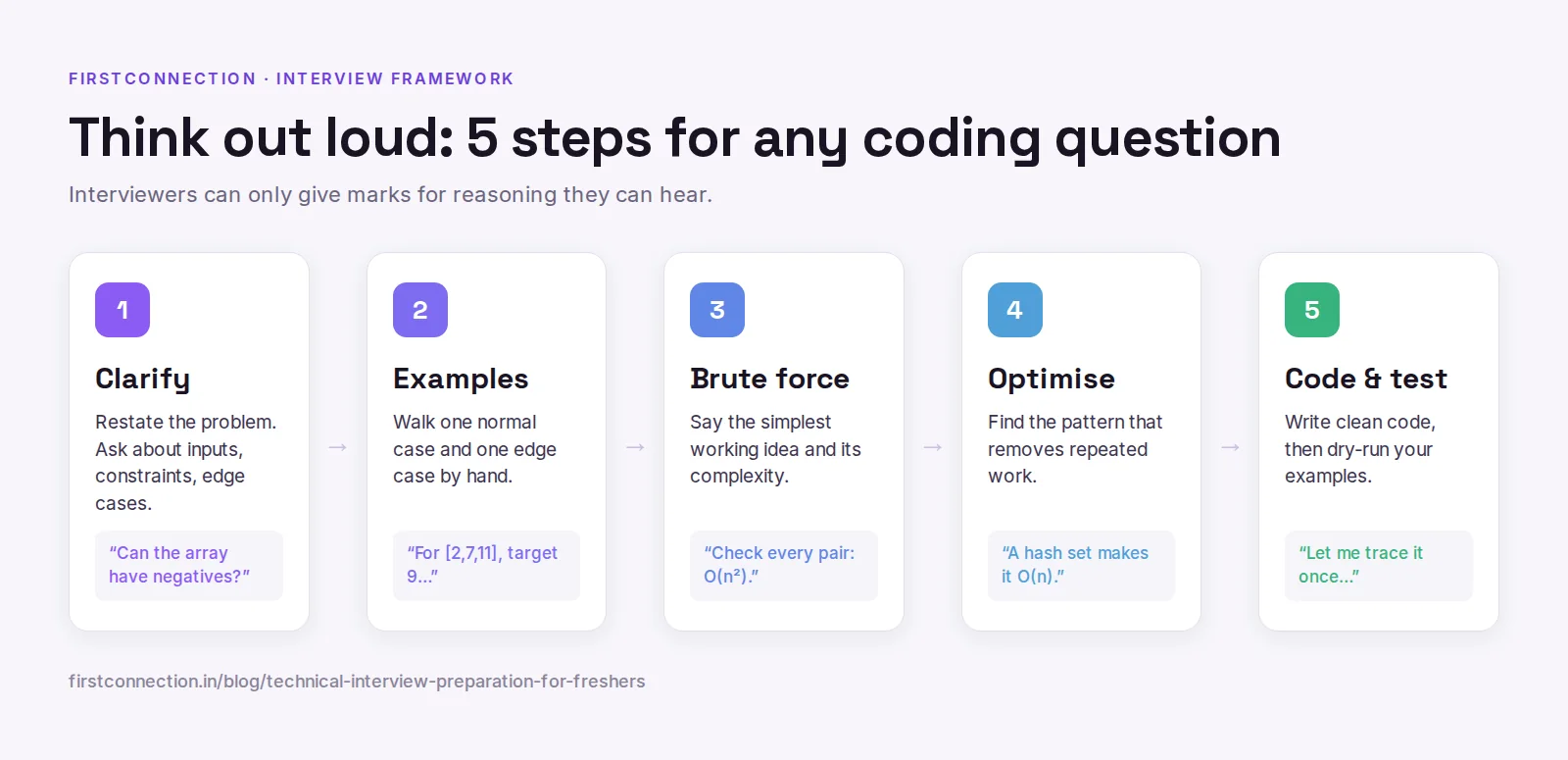
- Clarify. Restate the problem and ask about inputs, constraints and edge cases. "Can the array contain negative numbers? Is it sorted?"
- Examples. Walk through one normal case and one edge case by hand.
- Brute force first. Say the simplest solution and its complexity, even if it is slow. It proves you can solve the problem.
- Optimise. Look for the pattern (hashing, two pointers, sorting) that removes the repeated work, and say why it is faster.
- Code, then test. Write clean code with meaningful names, then dry-run it on your examples before saying "done".
> "My first idea is to check every pair, which is O(n²). Since we only need to know whether the complement exists, I can store the numbers I've seen in a hash set and get it down to O(n)." That one sentence shows the interviewer your reasoning, your knowledge of complexity and your ability to improve a solution.
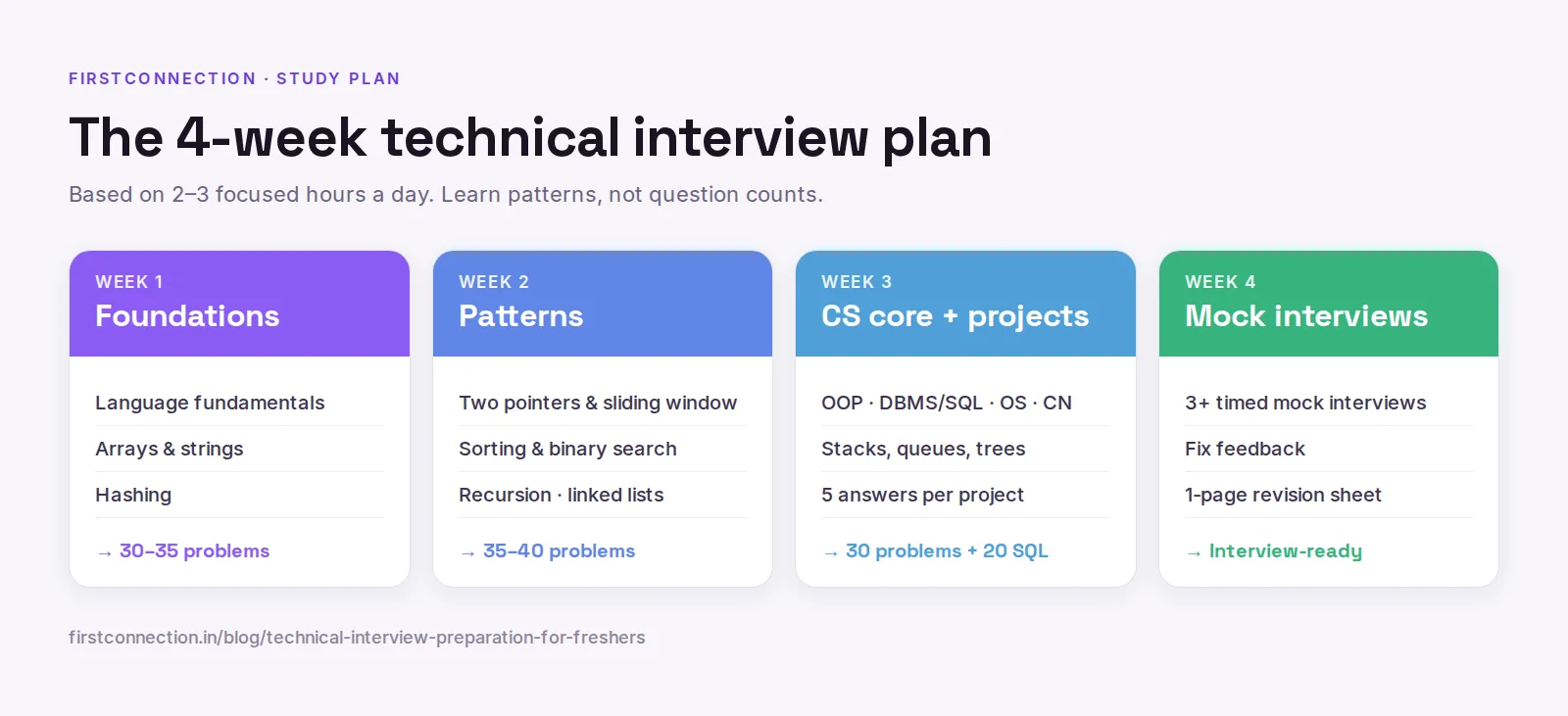
A 4-week technical interview preparation plan
Assuming 2–3 focused hours a day:
What to do when you don't know the answer
You will get stuck at some point, and so does everyone who interviews. What matters is how you handle it:
- Don't go silent. Say what you're thinking: "I'm considering sorting first, but that changes the indices…"
- Solve a smaller version. Try the problem with three elements, or without the hardest constraint.
- Ask for a hint gracefully. "Would it help to think about this as a graph?" Taking a hint well counts in your favour.
- Be honest about theory gaps. "I haven't worked with that directly, but here's how I understand it…" is far better than bluffing.
Day-before and interview-day checklist
- Revise your one-page notes and your project answers. Don't attempt new topics the night before.
- For online interviews, test your camera, microphone, internet connection and the coding platform. Keep a charger and a backup hotspot ready.
- Keep a copy of your resume, a notebook and a pen nearby for dry runs.
- Join five minutes early, sit in a quiet, well-lit space and dress as you would for an in-person interview.
- At the end, have one genuine question ready about the team, the tech stack or what success looks like in the first six months.
How FirstConnection helps you prepare
Preparation works best when you know exactly where you stand.
- Find your gaps first with Bharat Audit: a 75-minute, four-module placement readiness assessment that shows which areas need work before placement season, so you don't spend four weeks revising what you already know.
- Practise real interviews in Interview Arena: role-wise AI mock interviews that score your answers and give you a detailed Credo Report on what to fix. It's the closest thing to the real room.
- Ask someone who hires: with DTR Connect, you can book a WhatsApp session with a recruiter or senior professional and ask what their team actually looks for in freshers.
Take a mock technical interview in Interview Arena →